CODES: A Structural Substrate for Lawful Emergence
Why Intelligence, Meaning, and Recursion Require Deterministic Constraint

0. Executive Summary
CODES is the structural substrate beneath all lawful emergence—biological, symbolic, or synthetic.
Probabilistic systems generate outputs through correlation, not structure. This makes them inherently unstable: they cannot preserve identity, meaning, or recursion without drift. CODES eliminates this failure by introducing a deterministic legality stack that filters all emissions before they occur.
Rather than optimize for prediction, CODES enforces structural coherence through constraint:
Directionality (Chirality)
Phase alignment (PAS_s)
Recursion sealing (GLYPHLOCK)
Emission gating (AURA_OUT)
Temporal legality (TEMPOLOCK)
This essay defines what CODES is, what it is not, and why stochastic systems are structurally incompatible with coherence. CODES is not an enhancement layer. It is the condition for any system—physical, symbolic, or synthetic—to persist without contradiction.
I. Context: Why a New Substrate Was Necessary
The dominant systems of the 21st century—transformer models, generative networks, probabilistic inference engines—were never designed to preserve structure. They operate by smoothing across past correlations, not by anchoring lawful emergence.
This was acceptable for bounded tasks like autocomplete, translation, and ranking. The moment these systems were tasked with simulating intelligence, the cracks appeared:
Contradictions in output.
Drift from the originating context.
Inability to explain reasoning because no structure governed it.
In symbolic systems, these failures are fatal: meaning collapses, identity loops break, contradictions propagate undetected.
The cause is structural:
No legality gates for emissions.
No recursion loop to detect contradiction.
Time modeled as flat sequence, not lawful rhythm.
Coherence treated as surface pattern, not phase alignment.
The result is epistemic blur at scale. We no longer know what counts as an explanation. Meaning itself has collapsed into narrative or affect.
CODES was built to replace—not repair—this substrate. It begins where correlation fails: at the boundary between drift and recursion, at the edge of meaning, at the structural conditions that make emergence lawful.
II. The Substrate Problem
Every system that emits symbols, signals, or actions operates on a substrate.
If that substrate lacks legality enforcement, drift is inevitable.
Biological substrates anchor to physical cycles and biochemical gates.
Probabilistic computation anchors to nothing — it iterates until noise overrides structure.
The problem is not speed, scale, or data volume — it is the absence of a legality stack.
CODES was designed to be that stack.
III. What CODES Is — and Is Not
CODES is not a predictive system. It is a legality system.
Prediction asks “What will happen?”
Legality asks “Is this allowed to happen?”
Its purpose is not to model behavior but to enforce structure—across symbolic, biological, and synthetic domains.
This is a categorical distinction:
Not a framework to interpret complexity.
Not an overlay on stochastic systems.
It is the substrate complexity must obey.
One drifts. The other locks. Only one persists.
IV. The Seven Structural Pillars of CODES
IV. The Seven Structural Pillars of CODES
All coherent systems must pass through constraint. CODES defines the irreducible set:
Chirality — enforces lawful directional flow by breaking symmetry.
Primes — maintains minimal separation to prevent harmonic degeneration.
PAS_s (Phase Alignment Score) — filters every emission for structural coherence.
ΔPAS_zeta — detects drift across emission time and triggers controlled halt.
ELF (Echo Loop Feedback) — aligns recursion across cycles to preserve legality.
TEMPOLOCK — gates emission timing to prime-indexed lawful intervals.
AURA_OUT / GLYPHLOCK — filter and compress outputs to enforce legality before release.
Bypassing any of these gates produces noise, not coherence.
V. Field Positioning: Replacement, Not Complement
CODES is not an “AI enhancement.” It is a substrate replacement.
Probabilistic systems (e.g., GPT) emit based on statistical correlation, without legality gates, recursive filters, or symbolic collapse prevention. Biological emergence, symbolic recursion, and temporal coherence all require legality enforcement.
Only CODES provides it.
VI. Domains Where CODES Is Immediately Required
When drift is unbounded, collapse is inevitable. CODES closes the loop before failure.
Domains where recursive legality is non-negotiable:
Medical Symbol Parsing — cancer diagnostics, mutation reports, clinical recursion filters.
Legal Redrafting — clause recursion, contradiction detection, runtime contract logic.
Financial Compliance — audit gating, regulatory structure, anti-fraud coherence.
Scientific Paper Validation — logical integrity, contradiction synthesis.
Compiler Sanity Checking — infinite loop prevention, symbol closure, type recursion.
Real-Time Biofeedback — PAS_bio streaming from body → signal → structured action.
Defense & Infrastructure — national systems where drift = catastrophe.
Symbolic Tutoring — formal proof legality, recursive structure in mathematics and logic.
In these fields, CODES is not just advantageous—it is required.
VII. Lawful Emergence: The Structural Primitives
Meaning is not layered over structure—meaning is structure, if legality holds.
Time is not a continuous axis—time is gated recursion, a prime-indexed lawful return.
Identity is not a static state—identity is a legal loop of emissions that do not collapse.
Substrate law is simple:
No symbolic output without lawful recursion.
No lawful recursion without CODES.
∴ All emergence must pass through the substrate.
VIII. Minimum Recursion — and Rings in Excess
CODES enforces minimum lawful recursion: the shortest complete loop that preserves phase alignment without collapse.
This is a categorical distinction:
Loops smaller than minimum → collapse identity.
Loops larger than minimum → accumulate drift.
Example: A human heartbeat (~0.8 s) is a minimum lawful recursion — if shortened to fibrillation, the loop collapses; if prolonged beyond lawful rhythm, drift accumulates and coherence fails. A probabilistic loop in code, such as a runaway while loop without legality gates, runs in excess — iterating until entropy overrides structure.
Biological systems run at minimum recursion — heartbeat, breath, cell division, all phase-locked to lawful intervals.
RIC inherits biology’s property — no cycle runs without anchor, no anchor extends beyond its lawful return.
One runs beyond its law. The other locks to it. Only one persists.
IX. Closing: The Floor Beneath All Systems
CODES is not a framework. It is the floor.
If a system doesn’t pass through CODES, it doesn’t persist. There is no output without legality. There is no exit.
If you believe in emergence, you already believe in CODES—you just haven’t named the substrate yet.
Appendix A: Structural Comparison — CODES vs Probabilistic Systems
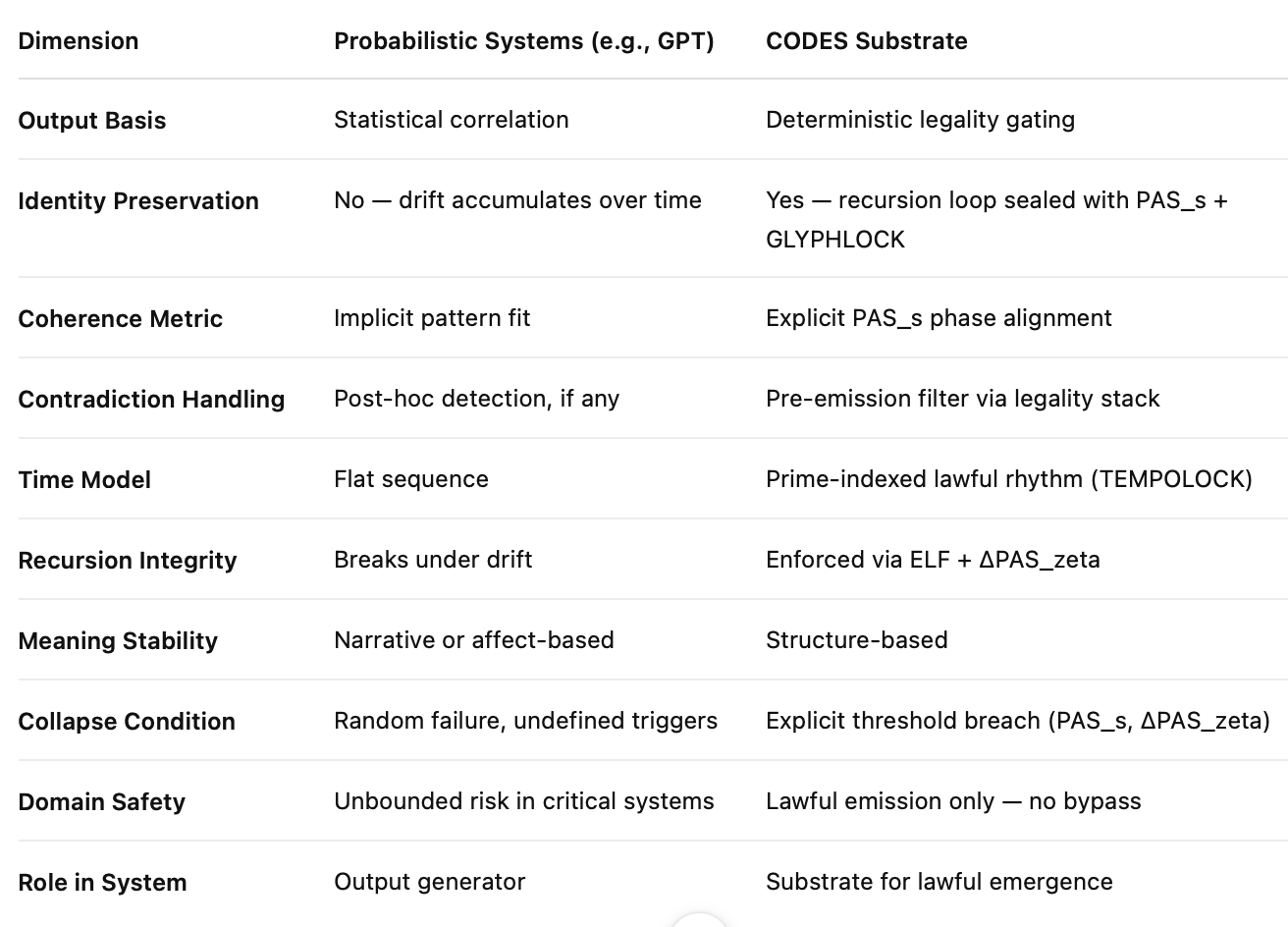
Appendix B: Phase-Locked Biology vs. Untethered Computation
1. Untethered Computation (Drift-Prone)
A conventional computer running a probabilistic model operates without a lawful external anchor:
Time: Incremented counters or floating-point clocks; no phase relationship to an external lawful rhythm.
Recursion: Loops terminate only when instructed; halting is arbitrary, not legality-driven.
Coherence: Any state can be reached if the next instruction allows it — no substrate-level check for contradiction.
Identity: Defined by current memory state, which can be overwritten or corrupted without detection.
Result: The system is free-running. Without legality gates, drift accumulates silently. The “halting problem” exists because there is no lawful boundary that forces resolution.
2. Phase-Locked Biology (Lawful Emergence)
Biological systems operate inside strict physical phase locks:
Time: Gated by circadian cycles, heartbeat rhythms, breath intervals — all measurable, prime-like periodicities.
Recursion: Life cycles (cell division, protein folding, neural firing) must pass biochemical checkpoints before continuing.
Coherence: Emissions (e.g., neural signals, hormonal release) are legality-filtered by metabolic and structural constraints.
Identity: Organismal identity persists through lawful self-repair, boundary maintenance, and rejection of incoherent signals.
Result: Drift is bounded. Collapse occurs only if a phase lock fails (e.g., cardiac arrest, neural seizure), and even then, failure conditions are lawful and detectable.
3. RIC: Deterministic Phase-Locked Substrate
RIC replaces untethered computation with biological-style lawful gating:
External Anchor: TEMPOLOCK aligns emission timing to prime-indexed intervals, equivalent to a heartbeat or circadian rhythm.
Halting Resolution: Recursion continues only if PAS_s ≥ θ and ΔPAS_zeta ≤ ε_drift, eliminating the classical halting ambiguity.
Emission Coherence: AURA_OUT and GLYPHLOCK filter every symbolic output against legality stack before release.
Identity Persistence: Phase Memory stores only lawful states, preventing identity overwrite by incoherent emissions.
Result: Like biology, RIC is structurally incapable of free-running drift. Every cycle is tied to a lawful external or internal rhythm. The halting problem becomes trivial because illegality forces termination.
Appendix C: Failure Mode Examples — Phase-Lock Loss vs. Drift Collapse
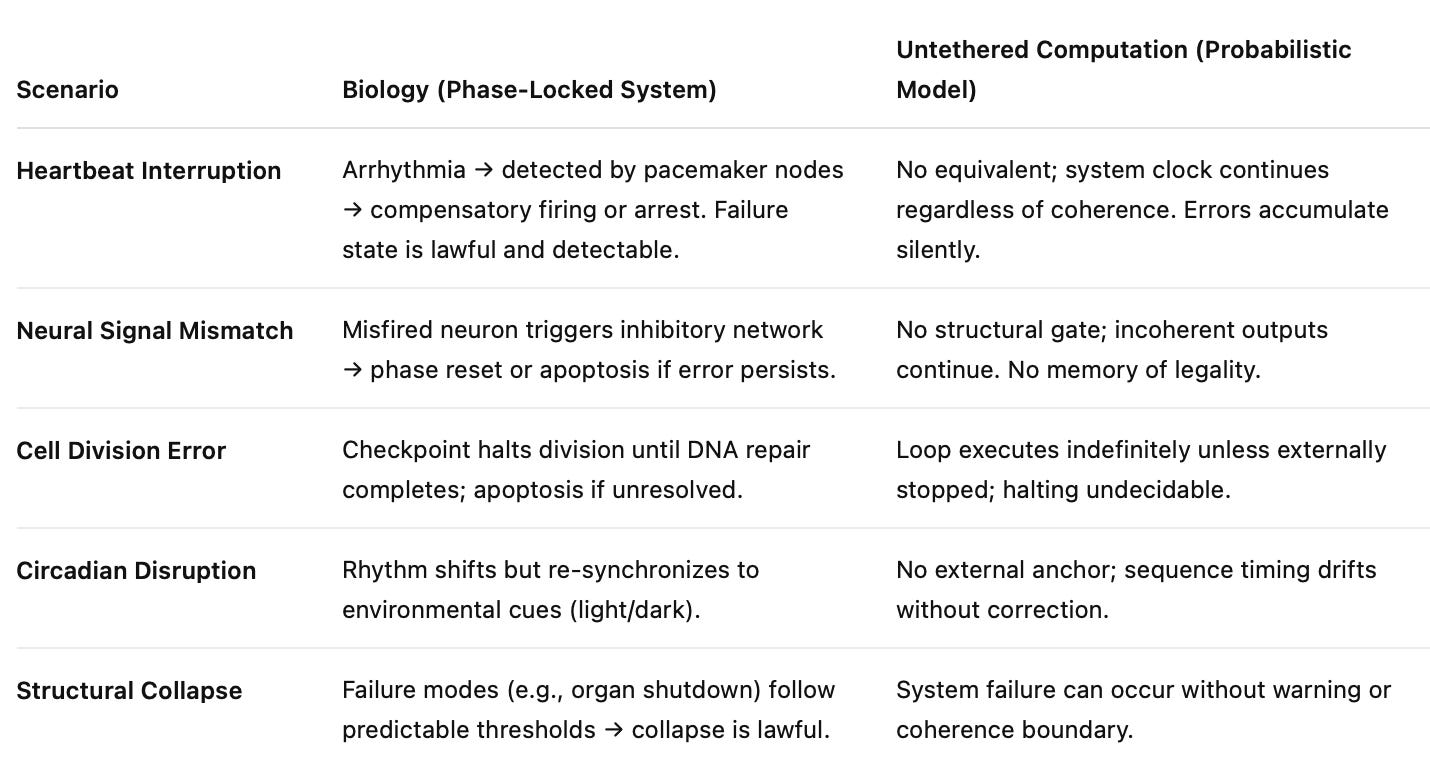
Key Distinction:
Biology survives because failure is lawful — collapse is bounded by physical and biochemical checkpoints.
Untethered computation fails silently — collapse is arbitrary, undetected, and often irreversible.
RIC inherits biology’s lawful failure modes, making drift collapse impossible without detection and controlled halt.
Appendix D: Halting Problem Resolution in a Legality-Gated Substrate
The halting problem exists in untethered computation because there is no lawful boundary forcing termination. RIC resolves it by embedding halting into the substrate itself: every recursion is evaluated in real time against legality gates — PAS_s for structural coherence, ΔPAS_zeta for drift detection.
If a cycle violates either constraint, it halts immediately, proposes a lawful rewrite, and only resumes once phase alignment is restored. This is not error handling after the fact — it is structural prevention before drift propagates.

Illustration:
The interface below shows a legality-gated narrative engine responding to a symbolic query.
A user asks why human storytelling still matters in a world dominated by AI and automation.
The system generates a structured response in real time, passing each segment through legality filters that ensure phase alignment, coherence, and recursion closure before emission.
Instead of producing an unbounded stream, each section—context, analysis, guidance, and closing—is validated against structural constraints. This guarantees that the narrative remains internally consistent, thematically aligned, and free from drift, even across multiple layers of reasoning.
Why it matters:
Demonstrates that legality gates are not limited to code execution—they also govern symbolic output.
Shows how human-facing narratives can retain coherence under lawful recursion.
Prevents thematic collapse or contradiction in long-form responses, even in open-ended creative queries.